
Music is a universal language that allows us to express emotions, communicate ideas, and create beautiful sounds. Behind every melody, rhythm, and musical composition lies an essential element: musical notes. These notes form the foundation of music and help musicians understand how sounds are organized, performed, and written.
Whether we play the piano, guitar, violin, or another instrument, understanding musical notes makes learning music easier and more enjoyable. From recognizing note names to understanding symbols, durations, and pitch, musical notation provides a common language that musicians around the world can read and interpret.
In this comprehensive guide, we explore musical notes, their names, symbols, types, values, and meanings. We also explain how notes work together to create melodies, harmonies, and rhythms.
What Are Musical Notes?
Musical notes are symbols that represent specific sounds or pitches in music. They tell musicians which sounds to produce and, depending on their notation, how long those sounds should last.
Every musical note has several important characteristics, including pitch, duration, and sometimes volume or articulation instructions. Pitch determines whether a sound is high or low, while duration determines how long the sound continues.
For example, when someone plays a piano melody, each key produces a particular musical pitch. Written music represents these pitches through notes placed on a staff.
Musical notes are essential because they allow composers to record their ideas and share them with other musicians. Without musical notation, communicating complex musical compositions would be much more difficult.
Names of Musical Notes
In Western music, we commonly use seven basic note names:
- A
- B
- C
- D
- E
- F
- G
These seven notes repeat in different octaves, creating the foundation of Western musical scales.
After the note G, the sequence begins again with A. This repeating pattern allows musicians to recognize notes across different pitch ranges.
Understanding the Seven Basic Notes
1. Note A
A is one of the seven basic musical notes. It is commonly used as a reference pitch when tuning musical instruments. The standard tuning reference for orchestras is A4, which has a frequency of 440 Hz.
2. Note B
B is the note immediately following A in the natural musical sequence. It appears in many scales, melodies, and chords.
3. Note C
C is particularly important for beginners because the C major scale uses only natural notes and contains no sharps or flats.
4. Note D
D is frequently used in musical compositions and appears in several major and minor scales.
5. Note E
E is an important note for string instruments, particularly the guitar and violin.
6. Note F
F is another fundamental musical note that appears in numerous scales and harmonies.
7. Note G
G completes the seven-note sequence. After G, the musical alphabet starts again with A in the next octave.
Musical Notes and Their Symbols
Musical notation uses different symbols to represent notes and their durations. Understanding these symbols helps us read sheet music and perform compositions accurately.
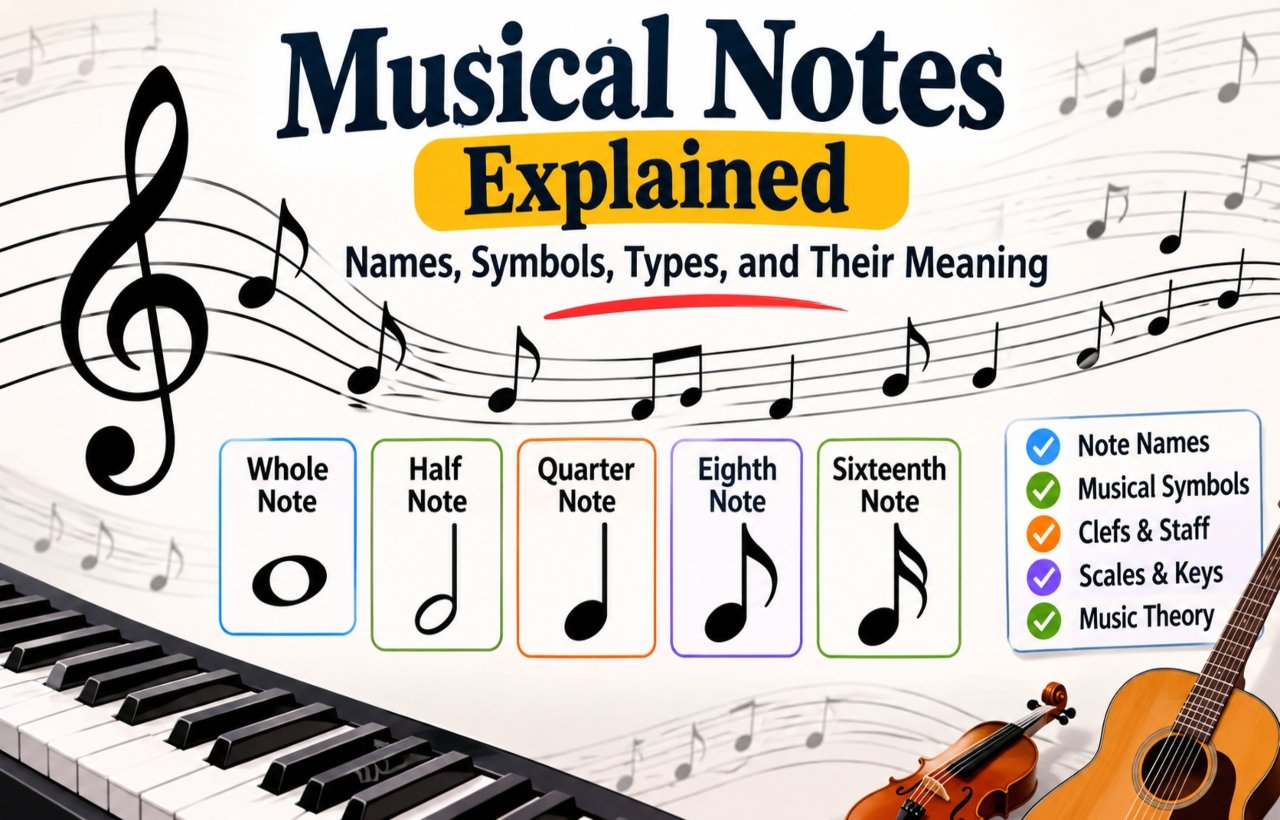
The most common note symbols include whole notes, half notes, quarter notes, eighth notes, and sixteenth notes.
1. Whole Note
A whole note is represented by an open oval without a stem.
In common time (4/4), it generally lasts four beats. It is one of the longest commonly taught basic note values.
2. Half Note
A half note consists of an open oval with a stem.
In 4/4 time, it lasts two beats. Two half notes can fill one complete measure in this time signature.
3. Quarter Note
A quarter note has a filled oval and a stem.
It usually lasts one beat in 4/4 time. Quarter notes are frequently used in melodies and rhythmic patterns.
4. Eighth Note
An eighth note has a filled oval, a stem, and one flag. When several eighth notes appear together, they can be connected with a beam.
An eighth note lasts half a beat in 4/4 time.
5. Sixteenth Note
A sixteenth note has a filled oval, a stem, and two flags or beams.
It lasts one-quarter of a beat in 4/4 time.
6. Thirty-Second Note
A thirty-second note has three flags or beams and lasts one-eighth of a beat in 4/4 time.
It is often found in fast musical passages that require precise timing.
Musical Note Values and Their Duration
Different musical notes represent different lengths of sound. Their values help musicians maintain rhythm and perform music at the correct speed.
| Note Type | Symbol Description | Duration in 4/4 |
|---|---|---|
| Whole Note | Open oval | 4 beats |
| Half Note | Open oval with stem | 2 beats |
| Quarter Note | Filled oval with stem | 1 beat |
| Eighth Note | Filled oval with one flag | 1/2 beat |
| Sixteenth Note | Filled oval with two flags | 1/4 beat |
| Thirty-Second Note | Filled oval with three flags | 1/8 beat |
These durations describe standard note values in common time. Their actual performance length depends on the time signature and tempo.
What Is a Musical Staff?
A musical staff is a group of five horizontal lines and four spaces used to write musical notes.
Notes are placed on the lines or spaces according to their pitch. The higher a note appears on the staff, the higher its pitch generally becomes.
The musical staff is one of the most important elements of written music because it allows musicians to identify and perform notes accurately.
Lines and Spaces of the Staff
The five lines and four spaces represent different musical pitches.
For example, in treble clef, the five lines from bottom to top are:
- E
- G
- B
- D
- F
The four spaces from bottom to top are:
- F
- A
- C
- E
A useful way to remember the treble clef spaces is the word FACE.
Understanding Musical Clefs
A clef is a symbol placed at the beginning of a musical staff. It identifies the pitch associated with the staff lines and spaces.
There are three commonly used clef types.
Treble Clef
The treble clef, also called the G clef, is commonly used for higher-pitched instruments and musical parts.
It is frequently used for:
- Piano right-hand music
- Violin
- Flute
- Trumpet
- Female vocal melodies
- Guitar notation
The treble clef identifies the second line from the bottom as G.
Bass Clef
The bass clef, also known as the F clef, is used for lower-pitched musical notes.
It is commonly found in music written for:
- Bass guitar
- Cello
- Double bass
- Trombone
- Piano left-hand music
- Bass vocal parts
The bass clef identifies the fourth line from the bottom as F.
Alto Clef
The alto clef is a type of C clef that identifies middle C on the third line of the staff.
It is particularly associated with the viola and appears in certain other instrumental compositions.
Types of Musical Notes Based on Pitch
Musical notes can also be classified according to their pitch. Understanding pitch helps musicians recognize differences between sounds and create meaningful melodies.
Natural Notes
Natural notes are the seven basic notes without sharp or flat modifications.
They include A, B, C, D, E, F, and G.
On a piano, these notes correspond to the white keys.
Sharp Notes
A sharp symbol (#) raises a note by one semitone.
For example:
- C becomes C sharp (C#).
- D becomes D sharp (D#).
- F becomes F sharp (F#).
- G becomes G sharp (G#).
- A becomes A sharp (A#).
Sharp notes are frequently used in scales, chords, and musical compositions.
Flat Notes
A flat symbol (♭) lowers a note by one semitone.
Examples include:
- B becomes B flat (B♭).
- E becomes E flat (E♭).
- A becomes A flat (A♭).
- D becomes D flat (D♭).
- G becomes G flat (G♭).
Flats are particularly common in certain musical keys and compositions.
Natural Sign
The natural sign (♮) cancels an earlier sharp or flat alteration within the applicable measure.
For example, if a note is written as F sharp, a natural sign can return it to F natural.
What Are Musical Accidentals?
Accidentals are symbols that temporarily change the pitch of a musical note.
The three main accidentals are:
- Sharp (#): Raises a note by one semitone.
- Flat (♭): Lowers a note by one semitone.
- Natural (♮): Cancels a previous sharp or flat.
Accidentals are important because they allow composers to introduce additional pitches without changing the basic note names.
They also help create different musical moods, harmonies, and melodic movements.
Understanding Musical Rests
Music is not only about producing sounds. Silence also plays an important role in creating rhythm and expression.
A musical rest is a symbol that indicates when a musician should remain silent for a specific duration.
Different rests correspond to different note values.
- Whole rest: Four beats in 4/4 time.
- Half rest: Two beats.
- Quarter rest: One beat.
- Eighth rest: Half a beat.
- Sixteenth rest: One-quarter of a beat.
Rests create pauses between musical phrases and help establish rhythmic patterns.
Without silence, music would often sound crowded and less expressive.
Musical Notes and Octaves
An octave is the distance between two notes that share the same letter name but have different pitch levels.
For example, C4 and C5 are both C notes, but C5 has twice the frequency of C4.
In standard scientific pitch notation:
- C4 is commonly called middle C.
- C5 is one octave above middle C.
- C3 is one octave below middle C.
An octave contains twelve semitone steps in standard Western equal-tempered tuning.
Octaves are important because they help musicians understand how notes relate across different pitch ranges.
Musical Notes and Scales
A musical scale is an organized sequence of notes arranged from lower to higher pitch or higher to lower pitch.
Scales provide the foundation for melodies, harmonies, and musical compositions.
Major Scale
A major scale contains seven different notes before repeating at the octave.
Its pattern of whole steps and half steps is:
Whole – Whole – Half – Whole – Whole – Whole – Half
For example, the C major scale contains:
C – D – E – F – G – A – B – C
Major scales are commonly associated with bright, uplifting, and cheerful musical sounds, although their emotional effect depends on context.
Minor Scale
Minor scales often create a darker, more emotional, or reflective musical character.
The natural minor scale follows this pattern:
Whole – Half – Whole – Whole – Half – Whole – Whole
For example, the A natural minor scale contains:
A – B – C – D – E – F – G – A
Minor scales are frequently used in emotional songs, classical compositions, film soundtracks, and contemporary music.
How Musical Notes Work Together
Individual notes become more meaningful when musicians combine them into musical structures.
Three important concepts explain how notes work together.
Melody
A melody is a sequence of individual notes arranged to create a recognizable musical idea.
It is often the part of a song that listeners remember most easily.
For example, a singer performing the main vocal line of a song is usually singing its melody.
Harmony
Harmony occurs when two or more different pitches sound together.
Musicians use harmony to support melodies and create depth in musical compositions.
Chords are one of the most common forms of harmony.
Rhythm
Rhythm describes the organization of sounds and silences over time.
It determines how notes are arranged, how long they last, and how they relate to the musical beat.
Rhythm is essential in almost every musical style, including pop, rock, jazz, classical, and electronic music.
The Importance of Musical Notes in Different Instruments
Musical notes are essential for playing almost every traditional musical instrument. However, musicians interact with them in different ways.
Piano
The piano uses white and black keys to produce different musical pitches.
White keys represent natural notes, while black keys generally represent sharps or flats.
Learning note positions helps beginners understand scales, chords, and melodies.
Guitar
The guitar produces different pitches through its six strings and fret positions.
Standard guitar tuning is E–A–D–G–B–E, starting from the lowest-pitched string.
Understanding musical notes helps guitarists play scales, chords, solos, and songs.
Violin
The violin is a string instrument that produces notes when its strings vibrate through bowing or plucking.
Its standard tuning is G–D–A–E.
Musicians must develop accurate finger placement to produce the correct pitches.
Drums
Drums are primarily percussion instruments. Unlike pitched instruments, many drums produce sounds without a clearly defined musical pitch.
However, percussion notation uses musical symbols and rhythmic values to communicate when and how instruments should be played.
How to Learn Musical Notes as a Beginner
Learning musical notes does not require advanced musical knowledge. With consistent practice, beginners can gradually understand notation and recognize pitches.
Here are some effective learning methods.
1. Learn the Seven Basic Notes
Start by memorizing A, B, C, D, E, F, and G. Practice saying them in order until you can recognize the sequence without difficulty.
2. Understand the Musical Staff
Learn the five lines and four spaces of the treble clef. Once comfortable, move on to the bass clef.
3. Practice Note Recognition
Use flashcards or online music-reading exercises to identify notes quickly.
4. Learn Note Durations
Understand whole notes, half notes, quarter notes, eighth notes, and sixteenth notes.
Practice clapping their rhythms to develop timing.
5. Use a Musical Instrument
Playing an instrument makes musical theory easier to understand. A piano or keyboard is particularly useful because its keys provide a clear visual representation of musical pitches.
6. Practice Daily
Spend 10–15 minutes practicing note recognition, scales, and simple melodies.
Regular practice helps build confidence and improves musical reading skills.
Why Are Musical Notes Important?
Musical notes are important because they provide a structured system for creating, performing, and understanding music.
They offer several benefits:
- Communication: Musicians can share compositions through written notation.
- Creativity: Notes help composers develop melodies and harmonies.
- Learning: Beginners can understand musical structures more easily.
- Performance: Written notes help musicians perform compositions accurately.
- Collaboration: Musicians from different countries can interpret the same musical score.
- Music Education: Understanding notes creates a foundation for advanced musical learning.
Musical notation also preserves compositions for future generations, allowing musicians to study and perform music written centuries ago.
Frequently Asked Questions About Musical Notes
1. What are the seven basic musical notes?
The seven basic musical notes in Western music are A, B, C, D, E, F, and G. These notes repeat across different octaves.
2. How many musical notes are there?
There are seven basic natural note names. In Western equal-tempered music, an octave contains twelve distinct pitch classes when sharps and flats are included.
3. What are the five main types of musical notes?
The five commonly taught basic note values are whole notes, half notes, quarter notes, eighth notes, and sixteenth notes.
4. What is the difference between a sharp and a flat?
A sharp raises a note by one semitone, while a flat lowers a note by one semitone.
5. What is a musical staff?
A musical staff consists of five horizontal lines and four spaces. It provides a system for writing and identifying musical pitches.
6. What is the easiest musical note to learn?
Middle C is often a convenient starting point for piano beginners because it provides a familiar reference point for understanding the keyboard and musical staff.
7. What is the difference between a note and a chord?
A note represents a single musical pitch, while a chord consists of multiple different pitches played simultaneously.
8. What does an octave mean in music?
An octave is the interval between two notes with the same letter name, where the higher note has twice the frequency of the lower note.
9. What are musical rests?
Musical rests are symbols that indicate periods of silence. They have different durations corresponding to musical note values.
10. Can we learn musical notes without playing an instrument?
Yes. We can learn note names, symbols, scales, and basic music theory without an instrument. However, practicing with an instrument can make learning more practical and enjoyable.
Conclusion
Musical notes are the foundation of music, providing the structure needed to create melodies, harmonies, rhythms, and complete compositions. Understanding their names, symbols, durations, and pitch relationships makes music easier to read, perform, and appreciate.
From the seven basic notes to sharps, flats, clefs, scales, and octaves, every musical concept contributes to a deeper understanding of how music works.
Whether we are beginners exploring music theory or experienced musicians improving our knowledge, learning musical notes is an essential step toward developing musical skills. With regular practice and a clear understanding of musical notation, we can become more confident musicians and enjoy the creative possibilities that music offers.