
 By callumlangham@gmail.com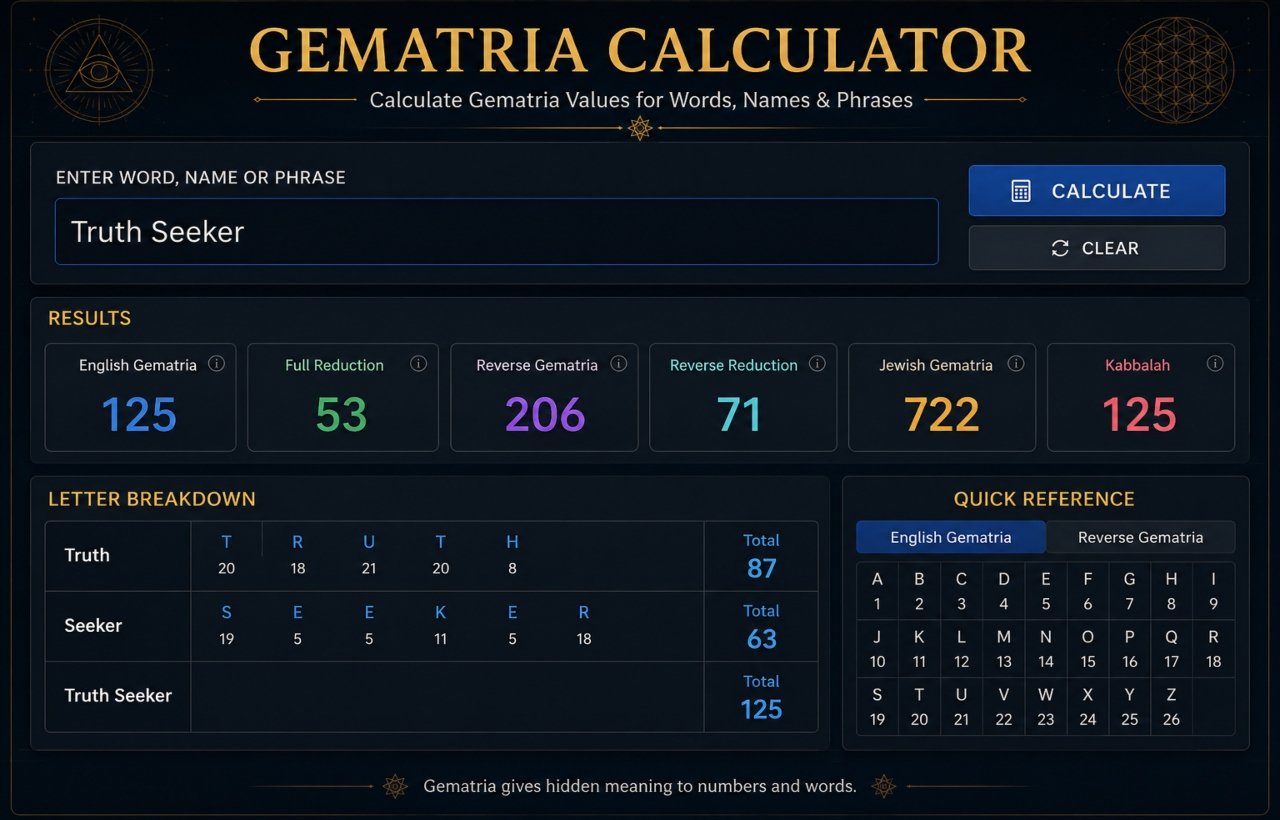
Gematria has fascinated scholars, mystics, and curious minds for thousands of years. Whether you’re a student of Jewish mysticism, a fan of numerology, or someone who just stumbled across the term “gematria calculator” while researching hidden meanings in names and words, this guide covers everything you need to know. By the end, you’ll understand what gematria is, how a gematria calculator works, the different systems used to calculate it, and how you can start calculating your own numbers today.
What Is Gematria?
Gematria is an ancient system of assigning numerical values to letters, words, and phrases. It originated in Jewish tradition and is closely tied to Kabbalah, the mystical branch of Judaism that explores the hidden layers of meaning within sacred texts like the Torah. The basic idea is simple: every letter in the Hebrew alphabet corresponds to a specific number. When you add up the numerical values of the letters in a word, you get its “gematria value.” Words or phrases that share the same numerical value are believed to be spiritually or symbolically connected, even if they appear completely unrelated on the surface.
This practice isn’t limited to Hebrew. Similar letter-to-number systems exist in Greek (isopsephy), Arabic (abjad numerals), and English (often used in modern numerology and occult studies). Today, people use gematria not just for religious study but for everything from numerology readings to analyzing names, dates, and even song lyrics.
What Is a Gematria Calculator?
A gematria calculator is a tool that automates the process of converting letters into numbers and adding them up. Instead of manually looking up the numerical value of each letter and doing the math by hand, you simply type in a word or phrase, select the gematria system you want to use, and the calculator instantly returns the total value.
This is especially useful because there isn’t just one method of calculating gematria. Different systems assign different values to letters, which means the same word can produce multiple different numbers depending on which method you choose. A good gematria calculator lets you switch between these systems so you can compare results.
The Main Types of Gematria Systems
Understanding the different calculation methods is key to using a gematria calculator effectively. Here are the most common systems you’ll encounter.
1. Hebrew Gematria (Standard/Mispar Hechrachi)
This is the traditional method used in Jewish mysticism. Each Hebrew letter has a fixed value, ranging from 1 to 400. For example, Aleph (א) equals 1, Bet (ב) equals 2, and so on up through the alphabet, with later letters representing tens and hundreds. This is the foundational system most other gematria calculations are built from.
2. English Gematria
Since English doesn’t have a built-in numerical alphabet like Hebrew, several systems have been developed to translate English letters into numbers. The most common are:
- Simple English Gematria: A = 1, B = 2, C = 3, continuing sequentially up to Z = 26.
- English Ordinal: Similar to Simple Gematria, this also assigns A = 1 through Z = 26, and is often used interchangeably with Simple Gematria in modern calculators.
- Reverse Ordinal: This flips the order, so Z = 1, Y = 2, down to A = 26.
- Full Reduction: Letters are reduced to a single digit using numerology-style logic (for example, J = 1, K = 2, and so on, cycling through 1–9).
- Jewish Gematria (English adaptation): A system that mirrors Hebrew gematria values but applies them to English letters.
3. Greek Isopsephy
Used in ancient Greek texts, this system works the same way as Hebrew gematria but with the Greek alphabet. It was historically used in early Christian numerology, most famously in debates over the “number of the beast” in the Book of Revelation.
4. Pythagorean Numerology
While not technically gematria in the traditional sense, Pythagorean numerology uses a similar letter-to-number method, reducing numbers down to single digits (1–9) based on numerological significance. Many gematria calculators include this option because of its popularity in modern numerology practices.
How Does a Gematria Calculator Work?
The process behind a gematria calculator is straightforward, even though the underlying systems can get complex. Here’s the general workflow:
- Input the word or phrase. You type in the text you want to calculate, whether it’s a name, a Bible verse, a phrase, or a random word.
- Select the gematria system. Choose from Hebrew, Simple English, Jewish, Reverse, or another supported method.
- Letter-by-letter conversion. The calculator breaks your input into individual letters and assigns each one its corresponding numerical value based on the system you selected.
- Summation. All the individual letter values are added together to produce the final gematria number.
- Results and matches. Many calculators also show you a list of other words or phrases that share the same numerical value, which is one of the most popular features for people exploring gematria connections.
Why Do People Use Gematria Calculators?
There are several reasons people turn to gematria calculators, and the motivations vary widely depending on the user.
Religious and spiritual study.
Scholars and students of Kabbalah use gematria to uncover hidden meanings in Torah verses. Certain numbers are believed to reveal connections between seemingly unrelated words, offering deeper insight into scripture.
Numerology and self-discovery.
Many people calculate the gematria value of their name or birthdate to explore what it might reveal about their personality, life path, or destiny, similar to how numerology charts are used.
Historical and academic research.
Historians and linguists sometimes use gematria to analyze ancient texts, inscriptions, and manuscripts where numerical wordplay was intentionally embedded by the original authors.
Pop culture and internet curiosity.
Gematria has found a home online, where people calculate values of celebrity names, song titles, dates, and current events out of curiosity or for entertainment.
Creative writing and puzzles.
Some writers and puzzle designers use gematria to embed hidden numerical codes into their work, similar to how cryptic crossword setters use wordplay.
How to Calculate Gematria by Hand
While a calculator makes the process instant, it can be helpful to understand the manual method, especially for Simple English Gematria, since it’s the easiest to learn.
- Assign each letter of the alphabet a number from 1 to 26 (A=1, B=2, C=3… Z=26).
- Write out your word or phrase.
- Look up the number for each letter.
- Add all the numbers together.
- The total is your gematria value.
For example, calculating the word “LOVE” using Simple English Gematria:
- L = 12
- O = 15
- V = 22
- E = 5
Adding these together: 12 + 15 + 22 + 5 = 54. So “LOVE” has a gematria value of 54 under this system.
Tips for Getting the Most Out of a Gematria Calculator
- Try multiple systems. Since different methods produce different numbers, comparing results across Hebrew, English Ordinal, and Reverse systems can reveal different layers of meaning.
- Ignore spaces and punctuation carefully. Most calculators skip spaces, but check whether punctuation is included, since this can slightly change results.
- Look for matching phrases. Many calculators show you other words or phrases with the same value, which is often the most interesting part of the process.
- Keep a record. If you’re studying gematria seriously, jot down the values of important names, dates, or phrases so you can compare them later.
- Understand the limits. Gematria is a tool for symbolic and spiritual exploration, not a scientific or mathematically rigorous system, so treat results as food for thought rather than definitive fact.
Common Questions About Gematria Calculators
Is gematria the same as numerology?
Not exactly. Gematria specifically refers to the practice of assigning numbers to letters, rooted in Hebrew and Jewish tradition. Numerology is a broader term that encompasses many number-based belief systems, including gematria, Pythagorean numerology, and others.
Which gematria system is the most accurate?
There’s no single “correct” system. Hebrew gematria is the most historically rooted, but Simple English Gematria and Jewish Gematria are popular for modern, English-language use. The right system depends on your purpose and tradition.
Can I calculate gematria for any word or phrase?
Yes. Gematria calculators can process names, sentences, dates written as text, and even entire passages, though longer phrases will naturally produce larger totals.
Do gematria calculators work for names?
Absolutely. Calculating the gematria value of a person’s name is one of the most common uses, often done out of curiosity about numerological meaning or symbolic connections.
Final Thoughts
A gematria calculator turns what was once a painstaking, manual process into something anyone can do in seconds. Whether you’re diving into centuries-old Kabbalistic tradition, exploring modern numerology, or simply curious what number your name adds up to. Understanding how these calculators work — and the different systems behind them — helps you get more meaningful and accurate results. Start experimenting with a few different words and systems, and you might be surprised at the hidden numerical connections you uncover.