
 By callumlangham@gmail.com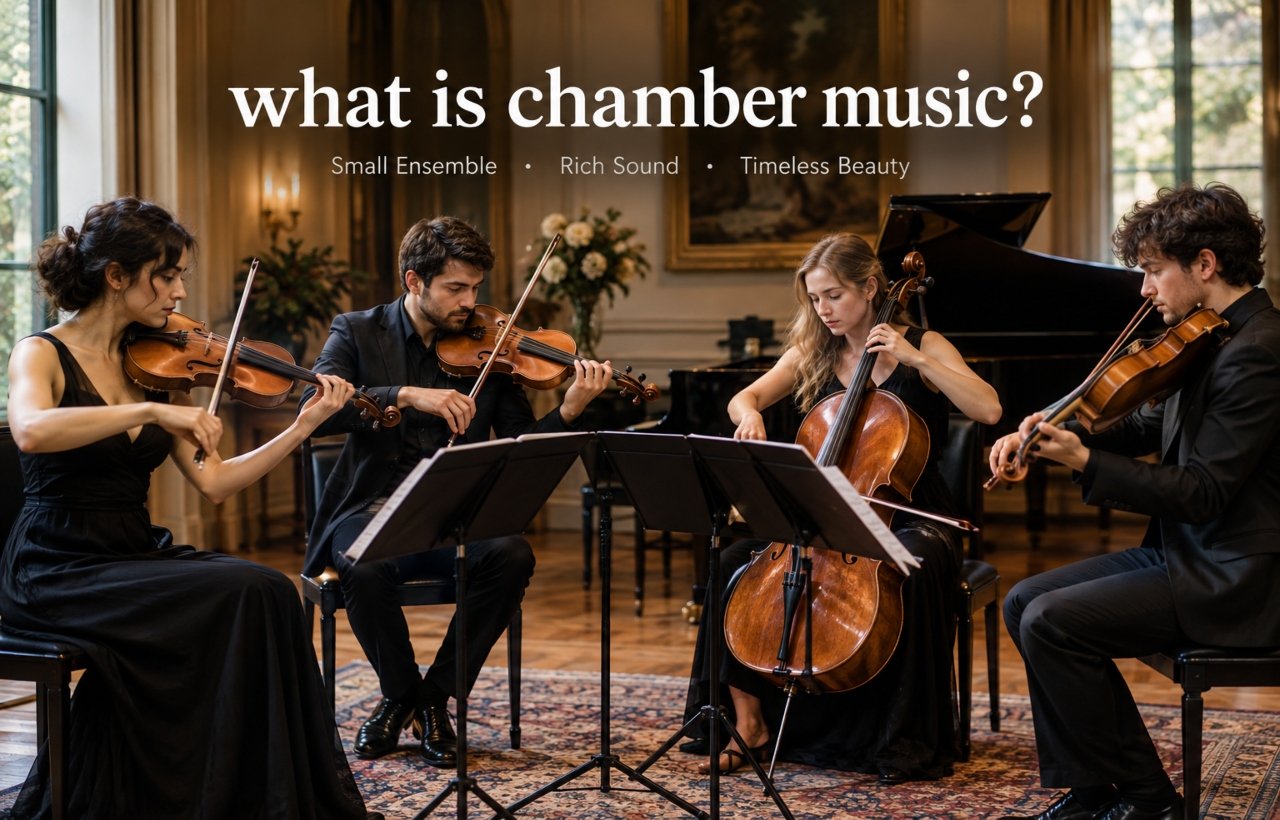
If you enjoy classical music, you may have heard the term chamber music. But what is chamber music, and how is it different from an orchestra or solo performance? Chamber music is a form of classical music written for a small group of musicians. Instead of performing with a large orchestra, musicians usually play together in a relatively intimate setting.
The term “chamber” comes from the idea of music performed in a private room or small hall. Historically, this type of music was often enjoyed in homes, palaces, salons, and other smaller spaces. Today, chamber music can be heard in concert halls, universities, churches, music festivals, and community performances.
One of its most interesting features is the close interaction between performers. Each musician usually has an important musical role, so the performance depends heavily on communication, timing, listening, and cooperation.
In this guide, we will explore what is chamber music, where it came from, the instruments commonly used, its major ensembles, and why this musical tradition remains important today.
What Is Chamber Music?
Chamber music is classical music written for a small ensemble, usually with one player performing each part. Unlike an orchestra, there is generally no large section of identical instruments. Instead, each performer contributes a distinct musical line.
For example, a string quartet normally includes two violins, one viola, and one cello. Each musician has an individual part. The players must therefore listen carefully to one another and respond to changes in rhythm, dynamics, and musical expression.
Chamber music can include anywhere from two performers to a small group of musicians. Although definitions can vary, ensembles with several dozen performers are generally considered orchestral rather than chamber groups.
The music can be serious, emotional, energetic, dramatic, or playful. Therefore, chamber music covers a broad range of styles and periods.
The History of Chamber Music
The roots of chamber music can be traced back several centuries. During the Renaissance and Baroque periods, musicians increasingly created music for smaller groups rather than exclusively for large public performances.
However, chamber music became especially important during the Classical period of the eighteenth century. Composers such as Joseph Haydn, Wolfgang Amadeus Mozart, and Ludwig van Beethoven helped establish many of the forms that remain popular today.
Haydn played a particularly important role in the development of the string quartet. His compositions demonstrated how several instruments could interact almost like different voices in a conversation.
Mozart also produced influential chamber works for strings, piano, and wind instruments. His music combined elegant melodies with complex musical structures.
Later, Beethoven expanded the possibilities of chamber music. His string quartets, piano trios, and other compositions explored deeper emotional expression and more adventurous musical ideas.
During the Romantic period, composers such as Johannes Brahms, Franz Schubert, and Robert Schumann continued the tradition while introducing richer harmonies and more expressive styles.
Consequently, chamber music developed from private entertainment into an important part of the classical music tradition.
Why Is Chamber Music Different From Orchestral Music?
One major difference between chamber music and orchestral music is the size of the ensemble.
An orchestra can include dozens of musicians. Several players may perform the same musical part. For example, an orchestra can have many violins playing together.
In chamber music, however, each musician usually has a more independent role. The performers must balance their sound without relying on a large instrumental section.
Another difference is communication. Chamber musicians often communicate through eye contact, body movement, breathing, and subtle musical gestures.
Moreover, chamber performances can feel more intimate because audiences are physically and acoustically closer to the performers.
Therefore, although chamber music and orchestral music both belong to the classical tradition, they offer different performance experiences.
Common Chamber Music Ensembles
There are many types of chamber ensembles. Each combination creates a different sound and musical character.
String Quartet
The string quartet is perhaps the most famous chamber music ensemble. It contains two violins, one viola, and one cello.
The first violin often carries important melodic material, while the second violin, viola, and cello provide complementary lines. However, the musical roles frequently change.
String quartets have been composed by Haydn, Mozart, Beethoven, Schubert, Brahms, and many other major composers.
Piano Trio
A piano trio usually contains piano, violin, and cello.
This combination provides a wide range of sounds. The piano can offer harmony and rhythmic support, while the violin and cello can carry contrasting melodies.
Piano trios became especially popular during the Classical and Romantic periods.
Piano Quartet
A piano quartet generally combines piano with violin, viola, and cello.
Because the piano can produce both melodic and harmonic material, it creates a rich sound when combined with three string instruments.
Composers such as Mozart, Schumann, and Brahms created important piano quartet compositions.
Wind Quintet
A wind quintet normally includes flute, oboe, clarinet, bassoon, and French horn.
Each instrument has a different tone and character. As a result, wind quintets can create colorful musical combinations.
This ensemble became particularly important during the nineteenth and twentieth centuries.
Brass Ensembles
Chamber music can also involve brass instruments. Small brass ensembles may include trumpets, trombones, French horns, and tubas.
These groups can produce a powerful sound while maintaining the close interaction associated with chamber music.
Duo and Trio Ensembles
Chamber music does not always require four or five musicians. Duos and trios are also common.
A violin and piano duo, for instance, can perform a wide range of classical compositions. Similarly, a flute and piano combination offers a bright and expressive sound.
How Do Chamber Musicians Perform Together?
Chamber musicians need strong listening and communication skills. Since every performer has an important role, one musician cannot simply depend on a conductor to control the entire performance.
Instead, the ensemble usually works together to maintain tempo, rhythm, balance, and expression.
Before a concert, musicians often rehearse difficult passages repeatedly. They discuss interpretation, dynamics, phrasing, tempo, and articulation.
During the performance, musicians watch and listen to one another. A small movement or visual signal can help performers coordinate an entrance or musical transition.
This collaboration is one of the defining characteristics of chamber music.
The Role of the String Quartet
The string quartet deserves special attention because it became one of the most important chamber music formats in Western classical music.
Its four instruments can create a surprisingly complete musical texture. The violin can produce bright melodies, the viola adds warmth, and the cello provides a deeper foundation.
However, the instruments are not restricted to fixed roles. A cello can carry the main melody, while a violin can provide accompaniment.
This flexibility allows composers to create musical conversations between instruments.
For this reason, string quartets remain popular among both performers and audiences.
Chamber Music During the Classical Period
The Classical period played an important role in shaping chamber music.
Composers emphasized balance, clarity, structure, and musical conversation. Chamber works from this period often contain clearly organized movements and themes.
Joseph Haydn is particularly important because he helped establish the string quartet as a major musical form.
Mozart later expanded the expressive possibilities of chamber music. His compositions often combine elegant melodies with sophisticated instrumental interactions.
The music of this period continues to be performed worldwide.
Chamber Music During the Romantic Period
During the Romantic period, composers began exploring stronger emotions, richer harmonies, and more dramatic musical structures.
Franz Schubert created chamber works filled with lyrical melodies and emotional contrasts. Robert Schumann explored expressive relationships between instruments, while Brahms developed dense and powerful musical textures.
As a result, chamber music became increasingly expressive.
The performers still worked as a small group, but composers used the format to explore complex emotional and musical ideas.
Modern Chamber Music
Chamber music did not disappear as musical styles changed. Instead, it continued to evolve.
Twentieth-century composers experimented with unusual instruments, new harmonies, different rhythms, and innovative techniques. Some modern chamber compositions sound very different from works by Mozart or Haydn.
Today, composers can write chamber music for traditional instruments, electronic instruments, or combinations that would have been unusual in earlier centuries.
For example, contemporary ensembles may combine classical strings with percussion, electronic sounds, or instruments from different musical traditions.
Therefore, chamber music remains a flexible and evolving form.
Where Is Chamber Music Performed?
Historically, chamber music was often performed in private rooms and aristocratic homes. Today, it can be heard in many different environments.
Concert halls remain important venues. However, chamber ensembles also perform in universities, churches, museums, libraries, cultural centers, and outdoor festivals.
Some organizations even organize house concerts where small audiences can experience performances in intimate spaces.
Because chamber ensembles do not require enormous stages, they can perform in a wide variety of locations.
Why Is Chamber Music Important?
Chamber music is important because it demonstrates the power of musical collaboration.
Each performer must contribute to the overall interpretation. No single instrument necessarily dominates the entire performance.
Furthermore, chamber music gives composers an opportunity to explore detailed relationships between instruments.
For students, chamber music can also provide valuable musical training. Young musicians learn how to listen, follow a shared tempo, balance their sound, and respond to other performers.
These skills can be useful in orchestras, bands, and other musical settings as well.
How Chamber Music Builds Musical Communication
One of the most fascinating aspects of chamber music is communication.
Musicians constantly exchange information through sound and movement. A performer may slightly change a phrase, and another musician can respond immediately.
Likewise, breathing can help coordinate an entrance. Eye contact can signal a transition. Body movement can communicate the direction of a musical phrase.
Because of this, chamber music can feel like a conversation without words.
Each performer listens carefully while also contributing an individual musical voice.
Chamber Music for Beginners
People who are new to classical music may initially find chamber music unfamiliar. However, it can be an excellent introduction to the genre.
The smaller ensemble makes it easier to hear individual instruments. Instead of hearing dozens of musicians simultaneously, listeners can focus on specific musical lines.
For example, during a string quartet performance, you might follow the first violin for one passage and then notice how the cello takes over the musical idea.
Listening in this way can make classical music more engaging.
A good starting point is to explore famous string quartets, piano trios, and other small ensembles from different historical periods.
How to Listen to Chamber Music
There is no single correct way to listen to chamber music. Nevertheless, paying attention to individual instruments can make the experience more interesting.
First, identify the instruments in the ensemble. Next, listen for the main melody.
Then, notice how the other musicians respond to it. Sometimes an instrument repeats a musical idea. At other times, another performer introduces a completely different theme.
You can also listen for changes in volume, tempo, rhythm, and mood.
With repeated listening, these details often become easier to recognize.
Famous Chamber Music Composers
Many influential composers contributed to chamber music.
Joseph Haydn is strongly associated with the development of the string quartet. Mozart created numerous important chamber works, while Beethoven pushed the form toward greater emotional and structural complexity.
Schubert created highly expressive chamber compositions. Brahms continued the tradition with rich harmonies and powerful musical structures.
Later composers, including Claude Debussy, Maurice Ravel, Béla Bartók, and Dmitri Shostakovich, expanded chamber music through new harmonic languages and approaches.
Their works demonstrate how adaptable the chamber music tradition can be.
Chamber Music and Music Education
Chamber music has an important role in music education.
Students who perform in small ensembles learn skills that individual practice cannot always develop. They must listen to others while simultaneously maintaining their own musical part.
Additionally, ensemble rehearsals teach patience and cooperation.
Students learn that playing the correct notes is only one part of a successful performance. Timing, balance, expression, and communication are equally important.
For this reason, many music schools and universities offer chamber music programs.
The Emotional Experience of Chamber Music
Chamber music can create a particularly personal listening experience.
Because the ensemble is small, subtle musical details can become more noticeable. A quiet phrase between two instruments can create a sense of intimacy, while a powerful passage involving the entire group can produce dramatic energy.
The emotional effect depends on the composer, composition, performers, and interpretation.
Some pieces may feel peaceful and reflective. Others can sound energetic, mysterious, joyful, or deeply emotional.
Consequently, chamber music offers a wide emotional range despite its relatively small ensemble size.
Chamber Music in Today’s World
Chamber music continues to have a place in modern musical culture.
Professional ensembles perform internationally, while amateur groups perform in schools, communities, and local organizations.
Digital platforms have also made performances more accessible. Listeners can discover chamber music through recordings, online concerts, educational videos, and streaming services.
At the same time, contemporary composers continue to create new chamber works.
This combination of tradition and innovation helps keep chamber music relevant.
Final Thoughts
So, what is chamber music It is a form of classical music designed for a small group of performers, with each musician generally playing an important and independent role.
Its history stretches back centuries, and its development has been shaped by composers such as Haydn, Mozart, Beethoven, Schubert, and Brahms. Over time, the tradition has expanded to include many different ensembles, instruments, and musical styles.
What makes chamber music special is the close relationship between performers. Instead of relying primarily on a conductor or large instrumental sections, musicians communicate directly with one another.
As a result, chamber music can provide both performers and listeners with an intimate and detailed musical experience.
Whether you are completely new to classical music or already enjoy orchestral compositions, exploring chamber music can reveal a different side of musical expression. From string quartets and piano trios to modern experimental ensembles, this tradition continues to offer something for almost every listener.