
 By callumlangham@gmail.com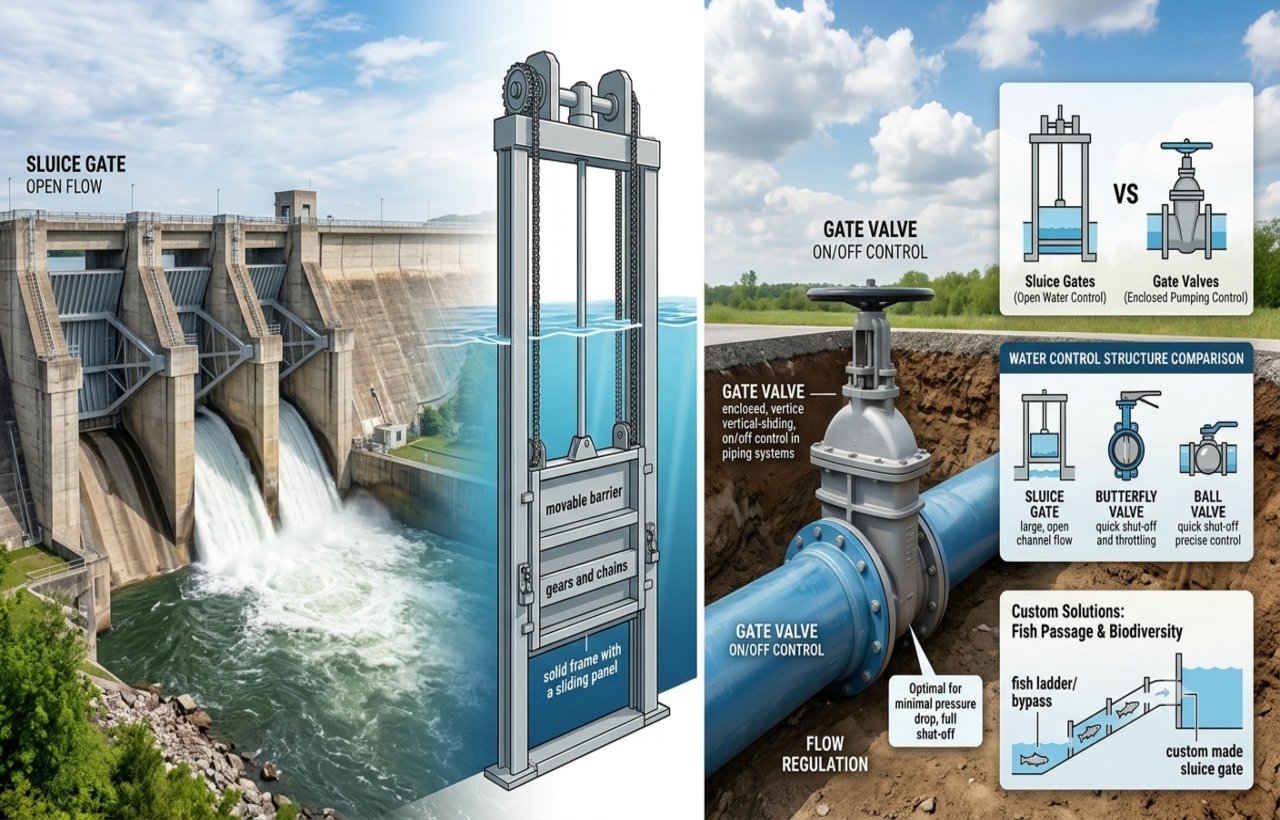
Water management is crucial for various applications, from irrigation to flood control. Among the many structures used for this purpose, sluice gate stand out as effective tools. Understanding their function and design can significantly impact water flow regulation.
This article explores the intricacies of sluice gates compared to other water control structures. Discover what makes them unique and how they fit into broader systems for managing water resources efficiently.
Understanding Sluice Gates
Sluice gates are vital water control structures used in various applications, such as irrigation and flood management. They regulate the flow of water through openings, allowing precise adjustments to meet specific demands.
These gates come with regional names that reflect local usage and culture. Their design typically involves a vertical or angled gate that can be raised or lowered to control water levels effectively.
Regional names
Sluice gates are known by various names depending on the region. In some areas, they are referred to as “sluices” or “slide gates.” These terms can vary significantly across different countries and cultures.
Understanding these regional names helps in identifying their usage and significance within local water management systems. Such variations highlight the importance of language in engineering practices around the world.
Description
A sluice gate is a movable barrier used to control water flow in canals, rivers, and reservoirs. It typically consists of a solid frame with a sliding panel that can be raised or lowered to regulate the passage of water.
These gates are essential for managing water levels, preventing flooding, and facilitating irrigation. Their versatility makes them valuable tools in both natural and engineered waterways.
Basic design
Sluice gates feature a straightforward design that primarily includes a movable barrier, often made of metal or reinforced concrete. This barrier can be raised or lowered to control water flow effectively.
Their operation is typically assisted by mechanical systems such as gears and chains. The simplicity in design allows for efficient maintenance and adaptability across various applications, from irrigation systems to flood management.
Custom-Made Sluice Gates
Custom-made sluice gates offer tailored solutions for specific water management challenges. They can be designed to fit unique applications, such as controlling water wheel systems or facilitating fish passage.
These made-to-measure designs ensure optimal functionality and efficiency. An example includes the Wey sluice gates at WWTP Schönau, which integrate seamlessly into their environment while addressing both human and ecological needs.
Controlling water wheel systems and fish passage
Sluice gates play a vital role in controlling water wheel systems, regulating flow rates, and ensuring optimal performance. By adjusting the gate’s position, operators can manage the amount of water that drives these wheels effectively.
Moreover, sluice gates contribute significantly to fish passage. They allow for controlled water movement while creating safe pathways for aquatic life, promoting biodiversity and ecological health in waterways.
Made-to-measure designs
Made-to-measure sluice gates offer a tailored solution for unique water control needs. These custom designs ensure optimal functionality in specific environments, accommodating varying flow rates and pressures.
Crafting these gates involves precise engineering to match site requirements. This customization not only enhances performance but also integrates seamlessly into existing infrastructure, providing efficient management of water resources while minimizing environmental impact.
Wey Sluice gates at WWTP Schönau
At WWTP Schönau, Wey sluice gates play a crucial role in managing water flow effectively. These gates are designed to enhance the efficiency of the wastewater treatment process.
Their robust construction ensures durability while allowing precise control over water levels. This adaptability is vital for maintaining optimal operational conditions within the facility, ultimately supporting better environmental outcomes.
Animal action integration
Integrating animal action into sluice gate design enhances ecological balance. This ensures that wildlife, especially fish species, can navigate waterways without obstruction.
Custom-made solutions often include features like bypass channels or adjustable openings. These elements allow for safe passage while maintaining effective water control. Such thoughtful designs promote biodiversity and support natural habitats alongside human infrastructure.
Comparing Sluice Gates with Other Water Control Structures
Sluice gates play a critical role in water management, but they aren’t the only option available. When compared to gate valves, sluice gates offer larger flow control and are better suited for high-volume applications.
However, with their compact design, butterfly valves can be advantageous where space is limited. Ball valves provide quick shut-off capabilities, making them ideal for situations requiring rapid response times.
Sluice gates vs. gate valves
Sluice gates and gate valves serve distinct purposes in water control. They are primarily for managing flow levels, allowing for significant adjustments in large bodies of water. They excel in applications like irrigation and flood management.
In contrast, gate valves focus on stopping or starting the flow. Their design typically suits smaller systems where precise control is essential, making them less adaptable than sluice gates for larger environments.
Sluice / Gate Valves vs. Butterfly Valves
Sluice or gate valves are primarily used for isolation. Their design allows for minimal pressure drop, making them ideal in systems where flow control is crucial. They require a full opening to minimize turbulence.
Butterfly valves, on the other hand, provide quick shut-off and are more compact. They’re suitable for throttling flow but can introduce some pressure loss due to their disc design. Each serves distinct operational needs effectively.
Sluice / Gate Valves vs. Ball Valves
Sluice and gate valves are primarily designed for isolation, offering minimal resistance to flow when fully open. They excel in managing large volumes of water, making them ideal for applications like dams and reservoirs.
Ball valves, on the other hand, provide quick shut-off capabilities with a simple quarter-turn operation. They’re better suited for precise control in smaller pipelines but can struggle under high-pressure conditions compared to sluice gates.
Gate Valves vs. Check Valves
Gate valves are primarily designed for on/off control, allowing or blocking flow with minimal resistance. They operate by lifting a gate out of the path of the fluid, making them ideal for applications where full flow is needed.
Check valves, however, serve a different purpose. They prevent backflow by automatically closing when liquid attempts to reverse direction. This function is crucial in protecting systems from potential damage caused by backpressure.
Key Differences and Applications
Sluice gates and gate valves serve distinct purposes in water management. Sluice gates are primarily used for regulating flow, while gate valves control the on/off function of water flow.
The terminology can be confusing; both may refer to similar functions but are designed differently based on application needs. Understanding these differences is crucial for selecting the right structure for specific systems.
Why are there two different names for water control structures?
The terms sluice gate and gate valve often create confusion. Both serve to control water flow, yet they have distinct applications. A sluice gate typically regulates large volumes of water in rivers or reservoirs, while a gate valve is more common in piping systems.
Regional variations also contribute to the difference in terminology. Local practices and preferences shape how these structures are named and understood across various industries.
Key features of Sluice/Gate Valves in water systems
Sluice gates, often referred to as gate valves, play a crucial role in managing water flow. Their design allows for precise control over the volume and direction of water movement, making them essential in various applications.
These structures are robust and designed to withstand high pressures. They provide a reliable barrier when closed, ensuring that systems remain secure and efficient during operations.
Why gate valves are preferred in certain systems
Gate valves are often preferred in systems where a straight-line flow of fluid is essential. Their design allows for minimal pressure drop, making them ideal for high-flow applications like mains water supply.
Additionally, gate valves excel at providing complete shut-off when closed. This feature is crucial in situations requiring maintenance or repairs without disrupting the entire system’s operation.
How to Select the Right Water Control Structure
Selecting the right water control structure involves evaluating specific needs. Consider factors like flow rate, pressure conditions, and environmental impact. Each application may call for different designs.
Think about maintenance requirements as well. Some structures demand frequent servicing while others are more durable. Assessing these elements ensures a suitable choice that enhances operational efficiency and longevity in your project.
Factors to consider when choosing a gate valve for a water supply system
When selecting a gate valve for a water supply system, consider the flow requirements and pressure ratings. Ensure that the valve can handle your specific application without compromising performance.
Material choice is also crucial. Different environments may require corrosion-resistant materials to enhance durability. Take into account factors like temperature and potential exposure to chemicals in the water supply system for optimal functionality.
Operating Conditions and System Scale
The operational environment dictates whether an open-channel sluice gate or an enclosed gate valve is appropriate. High-volume open waterways (such as canals and spillways) rely on sluice gates, whereas pressurized, closed-pipe networks demand gate valves designed to sustain fluid head pressure without leaking.
Actuation and Automation Needs
Consider how often and how quickly the barrier must be operated:
-
Manual vs. Automated: Small agricultural gates can be operated via manual handwheels or stem screws, but storm control systems require motorized electric, pneumatic, or hydraulic actuators for rapid emergency responses.
-
Remote Monitoring: Modern infrastructure often integrates automated sensors to adjust gate height dynamically based on real-time water levels downstream.
Conclusion: Optimizing Water Infrastructure
Water management requires selecting the precise tool for every hydrological challenge. Sluice gates remain indispensable for open-channel regulation, flood mitigation, and large-scale agricultural flow control due to their structural durability and high discharge capacity.
By evaluating key factors—such as volume scale, spatial constraints, flow dynamics, and ecological impact—engineers can balance human infrastructure requirements with environmental sustainability to build resilient water distribution systems.